New online bidirectional dictionary has the last word
Updated: Jun 17
By Daniel Santacruz

Two Paris-based organizations have heeded the plight of those of us desperate for a new bilingual Ladino electronic dictionary.
Aki Estamos and Muestros Desaparecidos just launched a free bidirectional translator Judeo-Espanyol—French/French-Judeo-Espanyol and Judeo-EspanyolEnglish/English-Judeo-Espanyol that makes that wish a reality.
The link is https://judeo-spanish-translator.com
The words Ladino and Djudeo-Espanyol, or Judeo-Espanyol, are used interchangeably.
According to a press release from the two organizations, the translator relies primarily on the Judeo-Spanish lexicon Al Reverso, from the Muestros Dezaparesidos association, as well as other sources.
Generally, for a given word, the first translation comes from the Joseph Nehama dictionary, a favorite of many users. Still in its beta stage, the dictionary may contain mistakes, according to the organizations.
The dictionary was designed exclusively for Ladino and doesn’t rely on approximations from modern Spanish. Its database contains more than 17,000 entries in three languages, Ladino, French and English. A fast browser, Chrome or Firefox, is recommended.
Microsoft Corporation contributed $60,000 dollars toward the development of the project, which had the technical support of OpenAI.
After clicking on the link, you’ll be welcome by two windows with two boxes below, "Continue without email" and "Continue with my email."
You’ll be directed to the next step to start translating. Enter the text you want to translate in the empty space in the upper half below where it says “Translation direction English-Judeo Spanish.” If you want to translate from Judeo-Spanish to English, just press on the arrow next to “Translation direction."
To test a text from English into Jude-Spanish, I wrote: “The day is hot and I want to eat.”

I clicked the red box labeled Translate and this is what I got a few seconds later: “El diya esta kayente i kero arreventar/jallear/komer/mandjar/tomar/yantar/yentar/revanar/tomar un bokado.”
Not bad.
Then I decided to test it from Judeo-Spanish to English and wrote: “Los ke suven a la Tora estavan akompanyados kon kantes I el gabai esperava en la teva.”
This is what I got: “Those who went up to the Torah were accompanied with songs and the gabai was waiting on the pulpit.”
Not the best, but it is on the right track. My edited version reads: “Those who were called to the Torah were accompanied with songs as the gabai waited on the teva (or bima).”
For a Jewish audience, I left the words gabai, teva and bima in the original transliterated Hebrew. Gabai is a sexton and teva and bima are sometimes translated as “platform”and “pulpit.”
Next to Translate you have the History box, which has a record of the source text, or texts, you entered and the translations as well as the dates and times you entered them.
Users can suggest corrections or additions and one of the experts will review the suggestions, consider them and, if valid, will fix them.
To make a suggestion, enter the source words in English and then enter the corresponding corrections in Ladino. Variants must be separated by /, and a space before and after. Example: Tintamarre: dubara /estremesína/shamata.
The more the dictionary is used the more mistakes can be fixed, according to the organizations.
Another useful feature is the Grammar Assistant, located on the same line as the translation buttons. It opens a window in which the user can check a conjugation or suggest a rephrasing. Some examples of use are conjugations in the present indicative, give the feminine, or masculine, form of a word, or show expressions that contain the selection you entered.
Following is an analysis of two other online dictionaries:
Trezoro de la Lengua Djudeoespanyola. Ladino a traves de las Epokas-Diksionario amplio istoriko.
For years I have been using this 90,000-word dictionary, edited by author and translator Avner Peres, which is geared mainly for English speakers, with synonyms in Hebrew.
Known simply as “the Trezoro”, several of its examples, which number in the hundreds, are taken from Nehama’s and Isaac Moscona’s dictionaries.
Moscona, who died in 1985, was the former rabbi of the Sofia synagogue. His one-direction dictionary—Ladino-Bulgarian—never surpassed 20,000 words.
To be fair, the shortcomings of Moscona and Nehama’s dictionaries are understandable. Moscona’s was edited in the 1990s, before the digital era, and the Trezoro, although launched in the late 1990s, doesn’t have translation capabilities.


Diksionario de Djudeo-Espanyol a Castellano/Diksionario de Castellano a Djudeo-Espanyol
Guler Orgun, Ricardo Portal i Antonio Ruiz Tinoco.
Published in 2009 by Ladinokomunita, it features about 2,777 words.
As a translator and journalist I have learned over the years that no dictionary is perfect and sometimes you have to look up a word or expression in more than one source.
Following are comments about paper dictionaries and glossaries from my library that I use often and that you may have too:
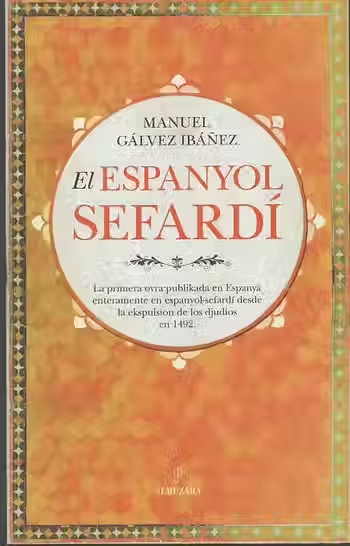
El Espanyol Sefardi. Manuel Gálvez Ibañes. Almazara, Córdoba Spain, 2024.
This comprehensive book, which claims to be the first published in Spain entirely in Ladino since the expulsion of the Jews from the Iberian Peninsula in 1492, has chapters on the history of Ladino, grammar, verb tables, holidays and common linguistic mistakes.
It features a 233-word Ladino-Spanish/Spanish Ladino dictionary.
Ladino-English/English-Ladino. Concise Encyclopedic Dictionary. Dr. Elli Kohen, Dahlia Kohen-Gordon. Hypocrene, New York, 2000.
This invaluable bidirectional reference tool for English speakers is packed with useful information. Definitions for the words include the origin as well as the cultural context of expressions and their usage.
Little did I know in 2000, when I purchased it, that it would give me a hand during difficult transactions.

Diksionario Ladino-Ebreo/Ebreo-Ladino. Matilde Koen-Serano. Kasa Editora S. Zak, Yerushalayim.
At over 900 pages, this is the most comprehensive bidirectional dictionary of its kind. Besides simple-to-follow verb tables, it includes several pages of riflanes, some from the author’s personal collection.
Diccionario básico Ladino-Español. Pascual Recuero Recuero. Amelier Ediciones, Barcelona, 1977.
The 3,000-plus glossary of this pioneer in Ladino publishing is culled from classics like Un marido entre dos muzeres, an anonymous novel; Sefer Hobat Halevavot, by Pahya ibn Pakuda; the Me’am Lo’ez, by Yaakov Huli; and others.
Sephardic Folk Dictionary English-to-Ladino/Ladino-to- English. Researched and compiled by Albert Morris Passy. Revised Second Edition. Published and printed by AMPCO, 1994.
Credit must be given to the compiler for the research and effort to publish this work, the only of this kind when it came out. It isn’t visually attractive and the binding and printing look unprofessional. The editing leaves much to be desired (uneven spacing, misplaced commas, occasional typos). It was a valuable resource back in the day, made obsolete by the Koens' much-superior encyclopedic Ladino-English/English-Ladino.
The fourth edition, published in 1999, is no different from the second, described above, except for a more attractive cover additional words.
This is the only Ladino dictionary that includes two pages of foul language in modern Salonika Judezmo, genital organs and male homosexual. Just in case you need them for your next translating job.
The following books have glossaries of hundreds of Ladino words with their equivalents in English and Spanish that can come in handy:
Studies in Sephardi Cultures: The David N. Barocas Memorial Volume, Sepher Hermon Press for the Foundation of Sephardic Studies and Culture and Sephardic House at Congregation Shearith Israel. Edited by Marc D. Angel. New York, 1980.
Edited by Sam Maimon, the Ladino-English glossary covers 168 pages.

La lengua florida: Antología Sefardí. Angelina Muñiz-Huberman. Universidad Nacional Autónoma de México, Fondo de Cultura Económica. México, 1997.
The 22-page Spanish-only glossary of this anthology of Sephardic literature includes proper names and the Hebrew roots of some words.
Ladino Reveries: Tales of the Sephardic Experience in America. Hank Halio. The Foundation for the Advancement of Sephardic Studies and Culture. Brooklyn, N.Y., 1996.
In this volume the author spins reminiscences of the American Sephardim from days gone by.
It features three glossaries: “Hebrew words commonly used in Djudeo-Espanyol,“ "Turkish Words Used Every Day in Our Djudeo-Espanyol” and “Ladino-English,” all totaling 21 pages.
Istoria Enteresante de la Ermoza Rahel: Novela anonima judeoespañola. Transliteración y estudio por Isaac Jack Levy. Wentworth Printing Corporation. Columbia, So. Carolina, United States, 2000.
Features a 16-page Ladino-English glossary.
Here are three classics if you like to cling to the past and speak French:
Dictionnaire Français-Judéo-espagnol. Joseph Nehama. Consejo de Superior de Investigaciones Científicas, Instituto Benito Arias Montano. Madrid, 1977.
Dictionnaire Français-Judéo-Espagnol. Klara Perahya, Elie Perahya, Asiateque. Paris, 1998.
El Nuevo chico diccionario Judeo-espanol-Frances de Selomo Yisrael Seresli (Jerusalen, 1898-1899) Edición anotada, estudio preliminar e índices by Aitor García Moreno, Peter Lang. Berlin, 2021.
June 17, 2026


Comments